
A Rising Branding Channel in Japan: Convenience Store Digital Displays


A Rising Branding Channel in Japan: Convenience Store Digital Displays
Japan is entering a new phase of gaming marketing that one where offline branding is back on the table for global publishers.
As Steam and console demand rises in Japan, multi-platform expansion has become the default strategy. However, at the same time, competition for attention is intensifying, and performance marketing alone struggles to scale awareness fast enough, especially for overseas titles entering Japan.
This is why we’re seeing renewed interest in Japan-specific offline channels, particularly with Convenience Store Digital Display Advertising.
Why now? Market structure matters.
Japan’s DOOH market is expanding, yet its structure differs from many overseas markets. Limited programmatic flexibility and fixed-location buying models create high cost barriers, while reach remains concentrated in major cities.
Convenience store digital display networks overcome these constraints through nationwide coverage and consistent daily exposure. As convenience stores serve as social infrastructure in Japan, their habitual usage provides structurally strong conditions for efficient, large-scale brand building.
Why is it a strong fit for gaming?
In Japan, publishers frequently activate this channel around launches, collaborations, and major updates for two strategic reasons.

1)Natural audience alignment.
The core gaming demographic (men aged 20–40) closely overlaps with heavy convenience store users. This enables repeated exposure to high-value players without relying on complex targeting models.
2)True nationwide scale.
Digital campaigns alone tend to concentrate impact in major cities. Convenience store networks extend physical reach into regional Japan, supporting broad familiarity and mass awareness—not just short-term, high-intent traffic.
Does it drive impact beyond awareness?
Recent example of SUBETE's impact, a title that ranked in the Top3 of Japan Steam sales in 2025 showed significant results through convenience store display ads. These ads not only boosted game awareness but also effectively drove purchases and play.

As illustrated in the data, branding through Japan’s convenience store networks contributes not only to strong awareness among new users, while also driving substantial conversion effects by moving users from interest to purchase intent.
Key Strategic Considerations for Execution
Successful deployment of convenience store digital display campaigns requires disciplined execution across three primary dimensions.
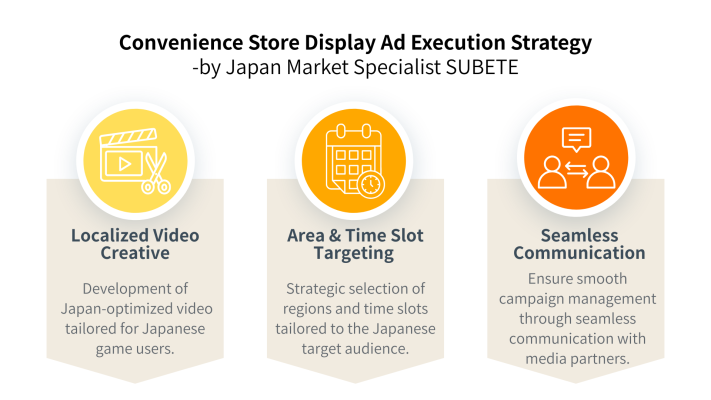
1) Advanced Localization of Video Creative
As video is the primary format, localization must go beyond translation. Creative should reflect Japanese gaming culture, use locally resonant language, and align with local visual norms. Even subtle adjustments can materially impact engagement and performance.
2) Strategic Region and Time-Slot Planning
Media design should reflect Japan’s distinct lifestyle patterns and consumption rhythms. This means balancing Tokyo with strategically important regional markets, optimizing timing and frequency, and aligning scheduling with campaign objectives. Precision in these variables is essential to maximize return on investment.
3) Operational Precision and Effective Communication
Executing campaigns in Japan requires multiple processes.
For global companies, language and cultural nuances can slow execution. An experienced local partner helps reduce friction, streamline coordination, and ensure timely, accurate launch.
Successfully executing campaigns in Japan requires collaboration with partners who possess deep local insight and operational expertise.
If your team is exploring branding initiatives in the Japanese market, SUBETE can help design a strategically grounded marketing plan tailored for impact. Let’s discuss how to build your presence in Japan effectively.


